

Is Stump Grinding Actually Necessary, or Can You Just Leave the Stump?
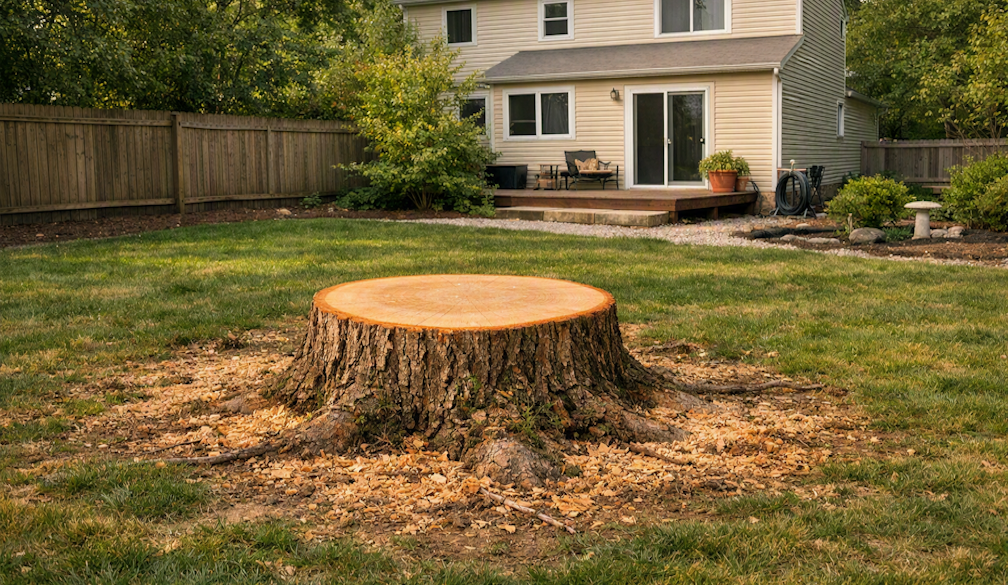
You can leave a stump. It is not illegal and nothing bad happens overnight.
But in most suburban yards, leaving it creates four problems: regrowth, pests, lost ground and a slow sinking hole.
That is why stump grinding services are usually booked with the tree removal instead of later.
Whether you actually need it comes down to four things:
- How close is the stump to your house or paving
- What species was the tree
- What do you want to do with that patch of ground
- How long are you willing to wait
Here is how to work out which side you fall on.
Leave It or Grind It?
|
Leave the stump |
Grind the stump |
|
|
Cost |
Nothing now |
One-off, cheapest at the same visit as removal |
|
Time to resolve |
5 to 15 years of rotting |
Same day, often under an hour |
|
Regrowth |
Common in gums, figs, willows, camphor laurel |
Stopped in almost all cases |
|
Pests |
Ongoing while the wood rots |
Food source gone |
|
Use of the ground |
Blocked for turf, paving, decking, fences |
Backfilled and ready to use |
|
Upkeep |
Mow around it, cut suckers, watch for sinking |
None |
|
Best for |
Acreage, back fence lines, bush blocks |
Lawns, small yards, homes for sale |
What Happens If You Just Leave It?
Year by year, this is the pattern.
- Year 1. Fungus on the cut face. Shoots push up from the base or from surface roots.
- Years 2 to 3. The outer wood turns soft and spongy. The centre and the main roots stay hard. Grass will not grow over the top.
- Years 4 and beyond.
None of this is an emergency. It is a slow nuisance in a spot you probably wanted to use.
Will the Tree Grow Back?
Often, yes. Cutting a tree down does not kill its roots.
Some species react to losing the canopy by shooting new growth from the base or from roots metres away. Eucalypts, poplars, willows, camphor laurel, privet, Chinese elm, and many figs all do this.
You end up with a bunch of thin, fast shoots that need cutting every few weeks. Skip a season and you have a, new multi-stemmed tree in the same spot, with weak joins that break in the wind.
Grinding takes out the base and the top of the root plate, which is where most of that regrowth starts. It works far better than repeat cutting or shop-bought stump killers, which struggle on big hardwood stumps.
Does a Stump Attract Termites?
It does not create termites. It feeds them if they are already nearby.
Termites eat wood. A rotting stump sitting in damp soil is a large, easy meal that can support a colony, and that colony keeps looking for more food. Borers, ants, and wood-rot fungi behave the same way.
Distance is what matters:
- Low concern. Small stump, 20 metres from a brick and slab house, dry area
- Real concern. Stump within a few metres of a timber-framed home, deck, fence, or retaining wall
If the stump is close to something built out of wood, get rid of it.
How Long Does a Stump Take to Rot Away?
Longer than most people think.
|
Wood type |
Rough timeframe |
|
Softwoods and fast growers |
4 to 8 years |
|
Medium hardwoods |
8 to 15 years |
|
Dense gums and ironbark |
15 years or more |
Warm and wet speeds it up. Dry soil and thick heartwood slow it down. Drilling holes and adding nitrogen help a little, but it will not turn a decade into a season.
If timing matters to you at all, waiting is not a plan.
When Is It Fine to Leave the Stump?
Leaving it is a fair call if two or more of these are true:
- It is well away from buildings, paving, pipes, and cables
- It sits on acreage, a bush block, or a back boundary
- The species does not sucker, and nothing has shot up after the first season
- It is small, so decay will finish the job in a few years
- You want to keep it as a seat, a planter, or a habitat log
- Machinery genuinely cannot reach it
If none of these are true, you are usually just delaying the job at a higher price, because a return visit costs more than doing it on the day.
What Does Stump Grinding Involve?
A grinder uses a spinning wheel with tough teeth to shave the stump and the top of the roots into chips.
- Depth. Usually 150 to 300mm below ground, deeper if you are laying turf or concrete
- The hole. Backfilled with the chips, which settle over a few weeks and often need topping up with soil
- Time. Under an hour for small and medium stumps
- Access. A narrow side gate, a slope or a retaining wall matters more than stump size
- Before starting. Underground services must be located because power, gas, water and irrigation lines often run near old trees
This is not good weekend work. Hire grinders are heavy, awkward on slopes and unforgiving if they hit rock, wire, or pipe, and kickback on a hardwood stump is a real risk. AB Trees does the removal and the grind in the same visit, which is cheaper and less disruptive than splitting the job into two.
Grinding or Full Removal?
Grinding shaves the stump down and leaves the deeper roots to rot. It is enough for turf, garden beds, paving, and normal landscaping.
Full removal digs the stump and root plate out with an excavator. It leaves a big hole and costs a lot more. You only need it for footings, a pool dig, in-ground services, or planting a new tree in the exact same spot.
Most home jobs only need grinding. A quick site check by qualified arborists will tell you which one applies, and it is worth asking them about your species and its regrowth habit while they are there.
So, Is It Necessary?
Grind it if the stump is somewhere you use, close to anything built, or from a species that grows back. In that case, the cost of leaving it shows up later as suckers, pest risk, unusable ground, and a sinking lawn, and none of that gets cheaper.
Leave it if it is out of the way on a large or bush block, small, and from a species that stays dead. It will rot down on its own and cost you nothing.
Work out which of those two your stump is, and the answer is obvious.
FAQs: Leaving a Stump vs Grinding It
Do I have to remove a tree stump?
No. There is no general rule forcing you to. It is a practical decision, not a legal one, unless your council or a development approval says otherwise for your site.
Is it OK to leave a stump in the ground?
Yes, if it is away from buildings and paving, on a bigger block, and from a species that will not shoot back. In a small yard or near a timber structure, grinding is the better call.
Is leaving the stump cheaper than grinding it?
Only at first. Later grinding costs more than doing it during the tree removal, and in the meantime you are paying in suckers to cut, lawn you cannot use and ground that dips.
Can I just leave it and kill it with stump killer?
Chemicals can work on small stumps, but they are slow and unreliable on large hardwoods, and the stump still sits there rotting for years. It solves regrowth at best, not the other problems.
Does leaving a stump affect selling the house?
It can. Buyers read a rotting stump near the house as a pest problem and a job they will inherit. Grinding is a cheap way to remove that doubt before photos are taken.
If I grind it, can I plant a new tree in the same spot?
Not straight away. Leftover roots and fresh wood chips make a poor start. Plant a metre or two away, or swap the chips for clean soil and wait a season.